
 English
  German
 "Take care of yourself, really!" I'll tell you here whether the usual warnings about traveling to Rio are really justified.
“Take good care of yourself! Rio de Janeiro is so dangerous!” My otherwise always cheerful mother and the rest of my family were really concerned who I told them that I would travel to Rio on my own. I tried not to laugh too much. After all, I’m living in Berlin-Neukölln, according to the media reports one of the worst corners in all of Germany!
How unsafe is Rio de Janeiro?
I’ve traveled halfway around the world, often alone, sometimes arriving in strange cities at night, without a plan, but also fearless, because hey, some cab will get me to my destination – but Rio de Janeiro? Rio, that’s apparently too dangerous. Dark favelas, drug gangs, shootouts and an eternal war between special forces of the military, police and gangsters, where good and evil are not necessarily always who they seem to be. Rising crime everywhere. Safety? A foreign word in Rio de Janeiro. Every day the news are full of muggings, flash kidnappings in the open street and tourists being robbed blind.

Rio de Janeiro and Safety: Is it all scaremongering?
At the same time, it seems to me that a certain carelessness in Rio de Janeiro with regards to crime is out of place. I remembered the story of some fellow crew member in Mexico City. (Can’t really say if this story is true, but you’ll get the point.) The aforementioned colleague was sitting in a sidewalk café in a chic district of Mexico City, and poof… the Rolex was gone. Just like that someone pulled it of his wrist. May be one of our legends in aviation, but still: You get the advice all the time to wear as little jewelry as possible or better, no jewelry at all.
Read also: 10 Best Things to Do in Rio de Janeiro

Hey, I’m Tatiana & the blogger behind The Happy Jetlagger. I write honestly, passionately and authentically about my travels. All tips have been researched by myself!
This is also one of the reasons why I prefer to travel alone in Southeast Asia, where (apart from the usual precautions such as not waving a packet of banknotes and the latest Chanel handbag in a train station district in the middle of the night, of course) you are largely unaffected by street crime and sinister characters.
Crime in Rio de Janeiro: Should we be afraid?
I wish I could write here that there is nothing at all to worry about in Rio, and that everything is pure exaggeration if you are not wandering the favelas on your own. However, I can remember a moment when I was walking in the evening through Santa Teresa, the new in district for creative people in Rio de Janeiro.
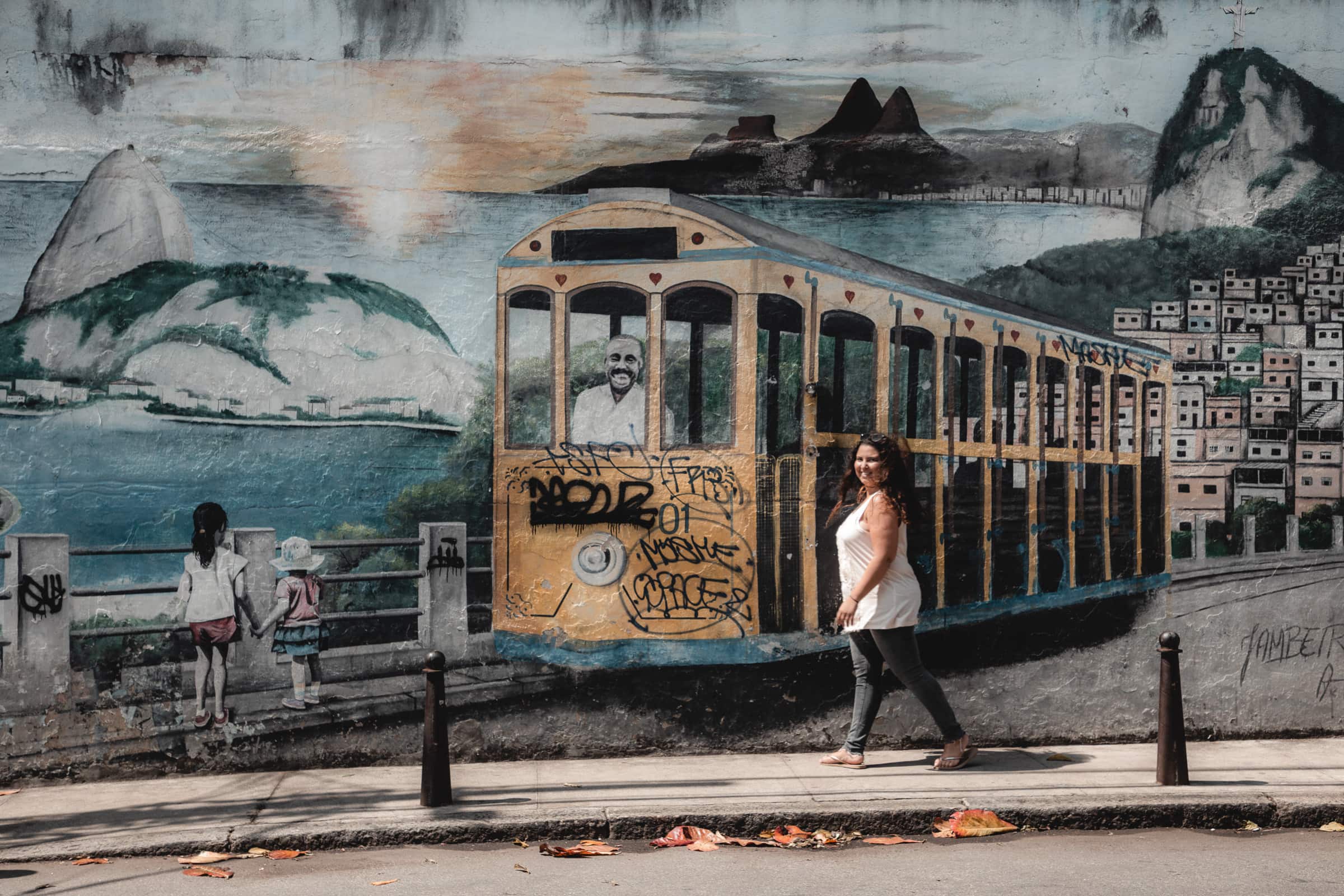
I had moved into an Airbnb there, next to the German consulate, which is guarded around the clock. Calmed me down a bit. Some Uber drivers had already pointed out to me that I might have to wait longer for a vehicle, Santa Teresa wasn’t exactly popular as it was outside the typical tourist areas such as Copacabana and Ipanema . Not many drivers would want to crawl up and down the winding mountain roads and besides, well, it would be a bit strange there from time to time…
Advertising / *affiliate link
Dangerous places in Rio de Janeiro (examples)
- Copacabana: Centrally located, many hotels and the famous beach are here. Copacabana looks relatively safe, especially during the day, due to everyday city life. Nevertheless, you should beware of pickpockets here around the clock. In the evening, as everywhere else, don’t walk along the beach even if it’s tempting. Stay on the promenade, have a drink in one of the bars and enjoy the night. Don’t be tempted to dip your feet in the water at night: Beaches aren’t illuminated and you might get robbed.
- Corcovado: At Corcovado there is a hiking trail up to the statue of Christ the Redeemer. Attention: Tourists are often being assaulted here. At the bottom of the climb, the police is present from time to time, but along the trail you are on your own. Better take alternative means of transportation up here.
- Favelas: Do not enter favelas on your own! As a non-resident, you’ll immediately stand out here. Join a guided tour if you are interested in life in a favela: for example, there are tours in Rocinha*, Vidigal* or Santa Marta*.
- Centro: After business hours, it gets shady pretty quickly in the center of Rio! Avoid the centro after the shop are closed or on Sundays at all costs! The streets are empty and there are some shady characters on the road.
Ad / *affiliate links
An evening in Santa Teresa – and an incisive experience
Santa Teresa is a very nice district at first sight. Once upon a time it was gloomier here, but now many artists and creatives have settled here, a pleasant vibe runs through the neighborhood, and somehow during the day it looks like the post-reunification Prenzlauer Berg under palm trees. The streets are lined with old villas of various types; the European immigrants who came here in the early 20th century brought a diverse range of architectural styles.
Read more about this interesting district of Rio de Janeiro: Santa Teresa Travel Guide
Dangers in Rio: Always be prepared!
And yet, the short five minutes I had to walk from my accommodation to the bar where I had an appointment had a certain tension in it. It was eight o’clock, already dark, in the middle of the week, and the streets were mostly deserted. I was on my to the Explorer Bar and suddenly two boys walked towards me. Just walking! I didn’t know if maybe they weren’t just on their way home or something.
So my panic level raised and I wasn’t even able to control myself anymore. I got sacred and suddenly I was running as fast as I could up the street on the other side. With slippery sneakers! It must have been a bizarre picture. Me, stumbling up the hill in panic, even though there was no danger all around. No question I took an Uber for the five minute walk at the end of the evening. And the driver was remarkably understanding: “Of course I’ll take you even if it’s just the few meters!” Better be safe than sorry.
Precautions are important
I definitelylost my nerves that evening. But it wasn’t that unreasonable. In my opinion, the only reason why there aren’t even more robberies and assaults happening in Brazil, but also especially in Rio, is because the population is used to take precautions all the time. You will see massive metal fences around apartment building entrances, hotel lobbies locked after dark or police checkpoints at tourist hotspots. Often, however, they are also corresponding behaviors; a certain caution that has crept into all areas of everyday life.
My Airbnb hostess, for example, said that the area in Santa Teresa wasn’t dangerous on one hand, but on the other she also advised me to only carry a copy of my ID (in Brazil, ID is mandatory at all times) and just little money, in case I get mugged. Or when I left the house with two pieces of luggage and left one suitcase briefly for a few minutes at the leaning gate in the middle of broad daylight, a neighbor warned me: “I’d better close it up, not that anyone gets any stupid ideas.” By the way, only hundred meters away and in sight was the German consulate, heavily guarded with security and everything.
Ad / *affiliate links
Evenings in Copacabana: Watch out!
Copacabana, the district where most tourists end up because of the famous beach, is no better, by the way. You also have to exercise a certain amount of caution here after dark. It was not without reason that the concierge at my hotel in Copacabana* locked the door after every guest entering or leaving. Once, I was chatting to a German friend outside the door (which was a bit uncomfortable for me, my Rio panic kicked in again), two tourists in the bright light of a hotel on an otherwise dark street – oh-oh, he didn’t unlock the door until I made an effort to go in. As if even in an emergency he would only watch from the inside. I don’t blame him, the way we were standing there outside wasn’t quite smart and immediately identified us as tourists. No carioca would probably do this.
Are you looking for accommodation in Rio?
Here you will find the best hotel deals as well as secure apartments!
Traveling solo as a female in Rio de Janeiro
Nevertheless, there are certain rules in Brazil as well, and Brazilians are by no means as open and liberal as you might think. For example, topless bathing is frowned or sometimes even forbidden in Brazil, depending on the location? Also, Brazilian men can be very flirtacious. My simple advice: be alert, but also relaxed, maybe your counterpart really just wants to have a nice conversation or flirt a bit. If it gets too much for you or you can’t assess the situation, however, you’d better be careful and follow your instincts!  Rio de Janeiro is incredibly green: In Rio’s national parks you can go for endless hikes
Rio de Janeiro is an experience in itself, I’ve been there several times and the city always gets me. I don’t want to scare anyone into going, but a few safety tips are worth their weight in gold. As a woman alone, I think it is feasible, but I always advise not to choose Brazil or even Rio if you have never traveled alone before.
Personally, I don’t see much difference between traveling to Rio solo as a woman or as a man. Probably the only thing you are more likely to encounter as a woman are numerous flirting attempts – which I personally don’t mind that much. Brazilians are very communicative by nature, and Brazilian men just like to try their luck. Still, no means no, and there are other places in the world where I have felt much worse than in Brazil (e.g. in Marrakech). In general, just be aware that Brazilians might seem a bit more touchy than people in other cultures, but also in a non-sexual way.
Safety tips for a trip to Rio de Janeiro (not only for solo travelers)
Here are a few golden rules for your stay in Rio:
(Many things go without saying and are nothing new, but in Rio you should simply exercise caution!)
Don’t wear flashy jewelry (think about the Rolex story!), clothing or accessories.
If you’re going to the beach take only with a cheap towel with you and at most a few Reais for a drink. Nothing else. Leave everything else like cell phone, camera, etc. in your accommodation. Even if you are traveling with several people and one person always stays with your stuff. You will quickly notice: no one, but really no Brazilian goes to the beach with huge luggage. Food and drinks are usually purchased on site at booths, beach bars or from passing vendors.
Especially with flashy camera equipment: pay attention to where you are! I actually used my camera, a Canon 5D Mark IV, in Rio, which gave me a lot of bellyache, since it is very expensive after all. However, I had already prepared it for travel anyway, so that it wouldn’t look conspicuous: I never use the enclosed camera strap, which, at least for Canon and Nikon, not only indicates the brand, but also the exact model. These straps are really noticeable. Most of the time I’ll put the camera on my cross-body strap, or I use old straps from analog cameras. I also cover model numbers etc. on the camera and lenses with black masking tape. Especially the red ring of Canon’s L lenses is quite eye-catching and immediately gives away professional equipment.
I finally booked a tour, then I could use the camera with less to worry. By the way, such small bus tours are also very popular with Brazilian tourists, a good atmosphere is guaranteed! I always recommend it to solo travelers, as it’s easy to make contact – and you can really relax in terms of safety.
Advertising / *affiliate link
Always keep an eye on your purse! Stow away your wallet that no one can easily access it! Avoid backpacks or carry them mainly in front of the body.
Always take only one copy of your ID with you (ID is mandatory in Brazil) and leave your passport at your accommodation.
Only ever withdraw money during the day and in monitored bank vestibules. Keep an eye out for strange characters in the vicinity. Tip: You can safely withdraw money in shopping malls.
Definitely take an Uber rather than public transportation if you’re arriving in the city with luggage. If you want to be on the safe side because it’s your first time in Rio or you’re tired from a long-haul flight, arrange your pick-up in advance.
Book a private airport transfer to the city here*
Advertising / *affiliate link
Always make sure you get into the right car when you call an Uber. Check the license plate!
When you go out in the evening: always watch your drink. Be careful with Caipirinha: It’s tasty, but it’s also pure alcohol and you’re likely to pay less attention when tipsy.
Avoid public transportation in the evening! Uber is cheap and safer.
Avoid the center of Rio after business or office hours and on weekends: This part of Rio is then completely deserted and there are many shady characters on the streets! Even in daylight, it’s very dangerous here on sundays!
Also be careful on lonely hiking trails in Rio’s national parks and up to Corcovado. Walk in groups and ask locals about the current situation.
Never explore a favela alone! If you are interested in life in the favela, you can book a favela tour*, for example. I’ve never participated in one myself, but they are supposed to be very interesting and often benefit the community.
If the worst should happen to you: In the event of a assault, no resistance, no discussion, give up everything, then go to the police.
Conclusion:
In general, I would not advise against a trip to Rio. However, especially as a European, you should be aware that you have to travel more attentively in Rio. In any case, you will be thrilled by Rio!
***
You can find more articles about Brazil here:
*Links marked with an asterisk (*) are affiliate links. If you book or buy something through them, I will receive a small commission. Thank you for your support!


