
 English
  German
 Find out why Saigon is an attractive stop for any trip to Vietnam in this detailed article about the top sights in Saigon or Ho Chi Minh City.
Are you planning a stopover in Ho Chi Minh City or Saigon during your trip to Vietnam? You’ve come to the right place: in this article, I’ll reveal my best Saigon tips and which Saigon sights you shouldn’t miss! Whether it’s the best street food, the coolest restaurants or the best accommodation: In this guide to Ho Chi Minh City (official name of Saigon!) you will find what you are looking for.

How to enjoy your stay in Saigon
Saigon may be the largest city in Vietnam, but it’s nowhere near as overwhelming as Bangkok or Hong Kong. The only thing that really takes some getting used to (and this applies to the whole of Vietnam in general) is the traffic with trillions of scooters, of which every Vietnamese seems to own at least one. Honking is a way of making yourself noticed in traffic, but you don’t flash your lights – so the traffic in a city like Saigon is simply a huge, loud wave of honking scooters. Mototaxis, scooters that you simply hop on, are also popular. Grab, a cab service similar to Uber where you can choose between a scooter or a normal cab, is also popular. However, when it was 40 degrees I usually took the car – and enjoyed the air conditioning. In general, Grab is an ideal way to get from sight to sight, it is cheap and much easier than traveling by public transport.
Why Saigon should be on your bucket list for your trip to Vietnam
It has now been four years since I was last in Vietnam. I left the country feeling very ambivalent at the time – somehow I didn’t get the full enthusiasm. I had previously only known Thailand in Southeast Asia, a country that makes it very easy for Western tourists to feel at home straight away. I had a slightly different experience in Vietnam. But more on that later. As I had visited the most important places in northern Vietnam such as Halong Bay, Hanoi, Hoi An, Hue and Da Nang last time and didn’t have time for the south, this time I wanted to get to know Saigon, the Mekong Delta and a few other places and try Vietnam again.
Are you planning a trip to Vietnam?
Find all articles and helpful tips for Vietnam here!

Hey, I’m Tatiana & the blogger behind The Happy Jetlagger. I write honestly, passionately and authentically about my travels. All tips have been researched by myself!


1. The Main Post Office Notre-Dame Cathedral
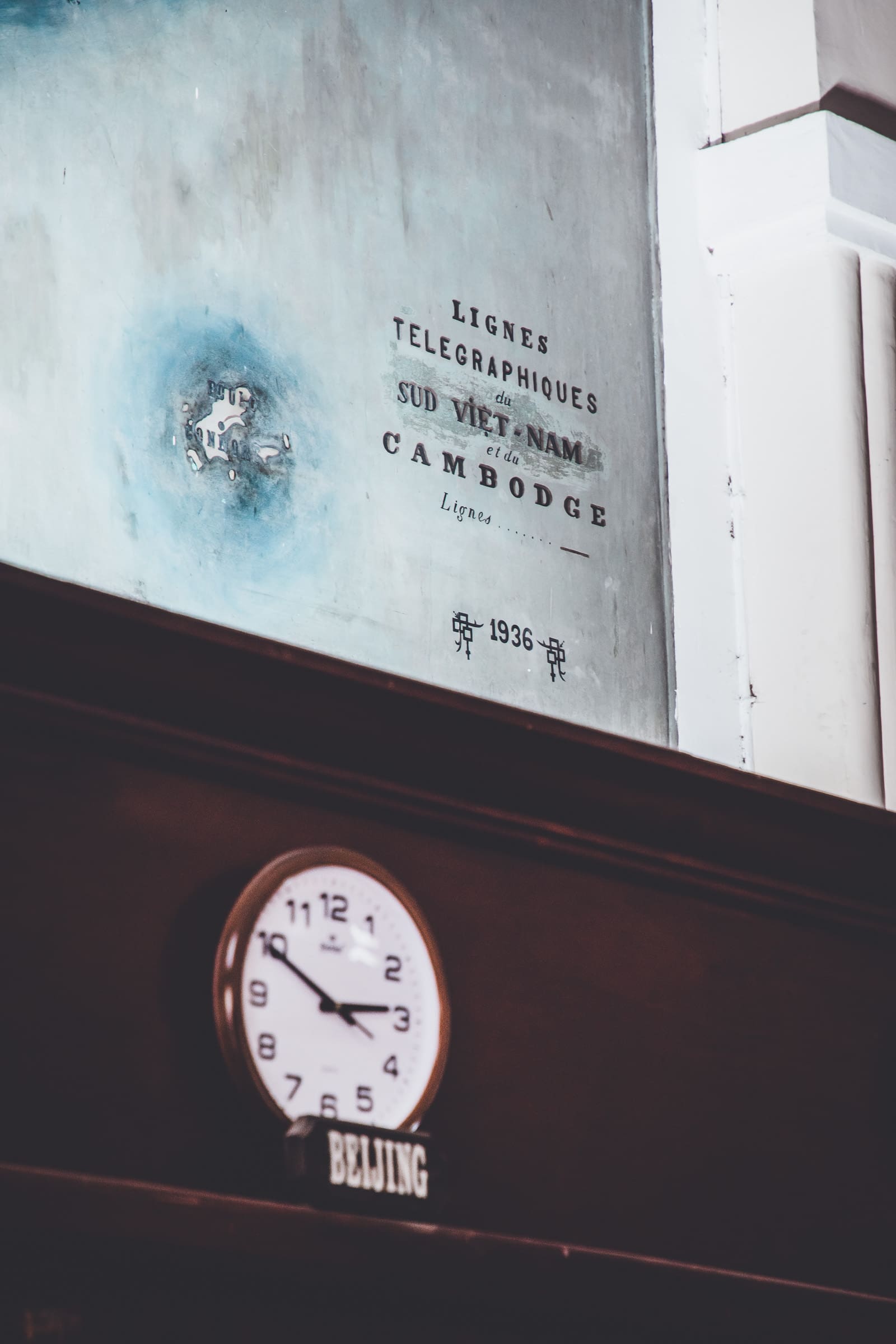
Saigon has few really spectacular sights, but many places are still interesting. The main post office, for example, was built during the French colonial era, and the steel structure inside was designed by Gustave Eiffel. A portrait of Ho Chi Minh hangs large at the head of the main hall. Strange: souvenir stores are located in the side wings as well as in the middle of the hall and the entire post office is filled with tourist groups, while all around the post office counters the normal business of buying stamps and collecting parcels continues.
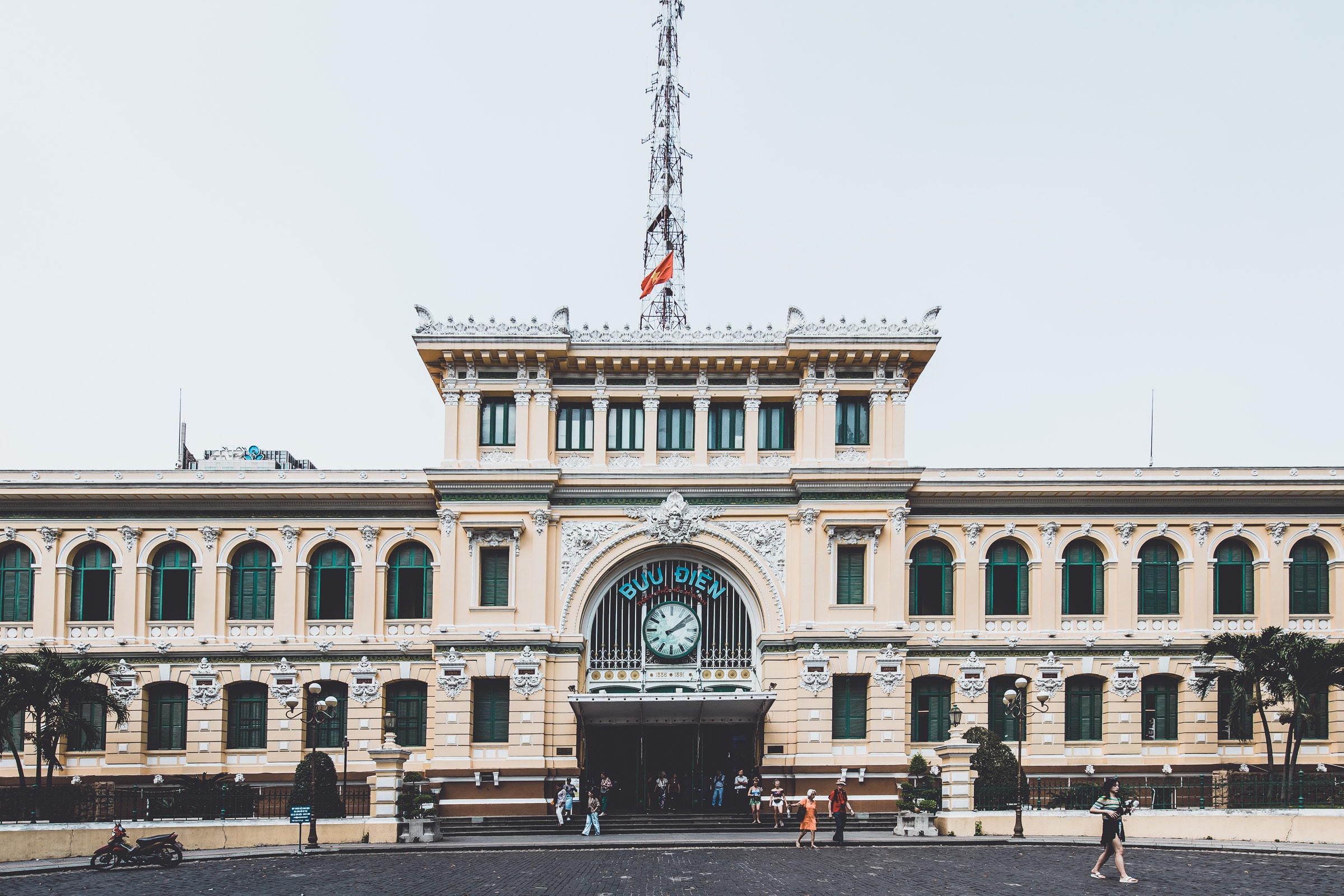

The great architectural influence of the French can also be seen in another of Saigon’s sights, Notre-Dame Cathedral (yes, there’s one here too!), just opposite the main post office. It is currently being renovated.

Advertising / *affiliate link
2. Ho Chi Minh City People’s Committee and Saigon Opera House
Two other sights from the French colonial era are the Ho Chi Minh City People’s Committee, the Saigon City Hall, and the Saigon Opera House. While the town hall cannot be visited, the opera house can be visited in connection with performances: The acrobatic show with South Vietnamese influences is said to be well worth seeing!
➜ Click here for the A-O and Teh Dar show at the Saigon Opera House*


3. Viewing platforms on the Bitexco Financial Tower Landmark 81
The Bitexco Financial Tower is Saigon’s second tallest skyscraper after the brand new Landmark 81 just outside the city. The large, protruding platform at the top of the tower is striking. However, this is not the viewing platform, but a helipad. It doesn’t seem to be used much – and it looks more like a prestige object. The Skydeck slightly below on the 49th floor is the publicly accessible viewing platform, where you can enjoy a view over Saigon for the equivalent of around 8 euros. Further up there is a restaurant/bar, which is free of charge, but understandably you have to consume something here.

Landmark 81 also has a viewing platform.
However, I gave myself the view from both locations as time was running out – and I already had a fantastic view of the city from the plane. The view of Saigon from the shore opposite is also magnificent! Tip: In the evening, this is the meeting place for locals – and couples who would like to (innocently!) spend time together, as this is problematic for young Vietnamese at home. There are the obligatory street food stalls and impromptu cocktail bars, and ending the day here on one of the folding chairs with the best view of the Saigon skyline is perfect! And best of all: no tourist fuss!

4. Ben Thanh Market
I always like going to markets in foreign cities – getting lost in the hustle and bustle and discovering exotic things, especially in faraway countries, is exactly my thing. The Ben Thanh market is located in the middle of the city – a large, covered market hall with fruit, vegetables, clothes, souvenirs and street food stalls. However, it is also a total tourist magnet, so if you prefer something more local, you should head for a market like the Tan Dinh Market or the An Dong Market.


There is also a well-known Pho restaurant, Pho 2000, right next to the Ben Thanh market. Pho is one of Vietnam’s national dishes that you should definitely try at least once! Pho is a noodle soup to which fresh herbs, chili and lime juice are added at the table. They are traditionally served with chicken or meat, often with tofu as a vegetarian option. Pho 2000, a simple restaurant, became famous after Bill Clinton slurped a Pho here on a state visit in 2000.


5. Reunification palace
The Reunification Palace was the seat of the South Vietnamese president before the Vietnam War. With the fall of Saigon on April 30, 1975 by the Vietnamese People’s Army and their tanks rolling over the fences, the Vietnam War came to an end. Today, the grounds and some of the rooms can be visited.

Ad / *affiliate links
6. War Remnants Museum
The War Museum was probably my biggest disappointment in Saigon. Many tourists I spoke to beforehand were very enthusiastic about the war museum, which is said to be one of the largest and best of its kind in Asia. I really looked at everything from top to bottom (the museum is spread over three floors) in the hope that I would learn something more about the historical context and background of the Vietnam War. I found the possibility that the portrayals might be biased quite exciting and somehow expected it. Although I had heard many times that the exhibition was quite neutral. In my experience, however, it is zero! In addition, the exhibition is technically very poorly designed. I was particularly interested in the photo exhibition of famous war photographers – but the actually impressive pictures are so poorly lit that it’s better to pick up a good illustrated book.

As expected, the exhibition is anti-American and completely omits the background of the opposing side. Understandable to a certain extent. But pretending to be neutral is very risky. Historical backgrounds are also only marginally illuminated, so that when I left the museum I didn’t have the feeling of being smarter about the history of Vietnam. I also found the self-evident presentation of American war equipment such as machine guns, bazookas and bombs on every corner very martial and disturbing. Belongs to the topic, but the shape and quantity was somehow too much.
I would therefore advise not to visit this museum with children!


My personal low point, however, was two other things: firstly, the souvenir store, which offers completely inappropriate souvenir items ranging from card games to American Hollywood movie posters to a biography of Michelle Obama or books such as “The Subtle Art of Not Giving a Fuck” by Mark Manson (when everything else here is anti-American, and with the latter book title, well…). – secondly, the fact that visitors can be photographed beaming with joy with the tanks in front of the museum. In the case of Asian visitors, a political background can perhaps still be accepted. But when I saw the two girls, obviously tourists from the West, who had a friend filming their cheerful cheerleading dance choreography between tanks and war helicopters, my jaw finally dropped.

7. Ho Thy Ky Flower Market
Vietnamese love flowers! Flowers are often used as decoration for the numerous festivals throughout the year or as religious offerings. At the Ho Thy Ky Flower Market, you can immerse yourself in a sea of flowers and sample delicious street food at the same time. Most of the flowers here come from the mountainous region further north around Dalat or from the Mekong Delta. Incidentally, I have tried in vain to find out what exactly is added to the flower water to keep them so incredibly fresh. Especially with air temperatures of almost 40 degrees… The chemical club probably sends its regards. (Incidentally, I have read that you should keep your hands off apples in Vietnam because they are sprayed so incredibly heavily – so be careful).

8. Tan Dinh Church / Pink Church
The special thing about this church is actually – as the name suggests – its color. Pink from top to bottom, even inside, this church is the sacred place of all Asian Instagrammers. At least that’s what it seems like when you see the hordes of young girls posing in front of the church, all looking for the best photo spot. (Search for #pinkchurch on Instagram!) I would have loved to see the inside of the church too – unfortunately there was a service.


9. Sri Mariamman Temple
The Hindu community in Vietnam is not particularly large, so the Sri Mariamman Temple near Ben Thamh Market is not that spectacular. But if you’re in the area anyway, it’s well worth a visit. Attention: shoes off!

10. Pham Ngu Lao – Backpacker Street with night market
After dark, the nightlife rages here! Booming basses, street food vendors with their little carts, girls, western tourists from backpackers to Neckermann Reisen, but also locals – you have to experience Pham Ngu Lao! During the Vietnam War, this street was home to restaurants and accommodation ranging from expensive to cheap. Here the American troops could stock up on everything they needed. Somehow the western influence has remained to this day and you can still find numerous bars and accommodation around the Pham Ngu Lao.

Excursions from Saigon: What else can you see?
A number of excursions can be undertaken from Saigon. A visit to the Cu Chi tunnels is popular. During the Vietnam War, the tunnel system that already existed during colonial times was extended by the Vietcong to create a complete infrastructure with housing units, hospitals and schools. What is special about the connecting tunnels is their size: 80 centimeters high, 60 centimeters wide. One section of the tunnel has been preserved to this day (and enlarged a little for the huge numbers of tourists from abroad) and can be visited.
➜ You can book your tour to the Cu Chi tunnels here*
Another popular excursion is a day trip to the Mekong Delta to visit the floating markets on the Mekong. However, a one-day tour is really very short, and the likelihood of ending up on a mass tour with a coffee tour character is very high. It seems advisable to book more days.
➜ Multi-day tours through the Mekong Delta*
I was also in the Mekong Delta after Saigon. But as I didn’t want to go back to Saigon for the time being, I went there on my own:
➜ C lick here for my article about the floating markets in the Mekong Delta
My very personal Saigon tips: Street Food & Cafés
Apart from the typical sights that can be found in every Saigon travel guide, I found a lot more exciting in Saigon! What I found particularly interesting were the many really great and unique cafés and restaurants, which even impressed me as a spoiled Berliner in this respect. And the delicious street food, which I would probably never have discovered without a great street food tour. But the best thing of all was the great locals, who immediately made me forget my bad experience last time and gave me lots of great tips. I often think that you should definitely visit a country a second time, even if the first time wasn’t particularly nice. Sometimes a country only reveals itself to you on a second visit.
Where can you get the best street food in Saigon? What is typical Vietnamese street food?
➜ More about street food in Saigon

Practical tips for Saigon – information for your trip
From the airport to the city
If you arrive at the airport by plane, you can either take a regular cab, Grab or the public airport bus into the city. The airport is only 7 kilometers from the city center, so a cab won’t be quite as expensive. I used Grab all the time because I read a lot about fake taximeters and fake cabs and I preferred Grab because, like Uber, the price is fixed from the start. From the city to the airport I once paid about 90,000 dong, which is about 4.50€. The only cheaper option is the airport bus, which runs via Ben Thanh Market to the bus station near Pham Ngu Lao: 20,000 dong, just under €1.
Continue by bus
If you want to continue by bus from Saigon, any hotel or travel agency will usually be able to help you. The mostly orange-colored FUTA Travel intercity buses are popular and good. They have offices all over the city, including near Pham Ngu Lao. You can buy a ticket there and will be taken by minibus to the bus station, which is located outside the city center. Prices are very reasonable, comfort is okay – the sleeper buses with their semi-flat reclining seats on 2(!) floors were perfectly adequate for my 1.60m height. Adult European men have a harder time of it.
Moving around the city
I can only recommend Grab within Saigon! Although there is good Wi-Fi on every corner and you can then use the app, I would recommend buying a local SIM card, which you can buy right at the airport. As in almost all Asian countries, these are incredibly cheap: a prepaid SIM card for 30 days and 2GB data volume per day (!) cost me the equivalent of around 10 euros.
Advertising / *affiliate link
Safety in Saigon: Is it dangerous in Saigon?
I have been warned several times by locals about bag and cell phone theft. Apparently, cell phones are often snatched from the hands of pickpockets riding past on scooters. Something similar happens with handbags or rucksacks that you only carry on one shoulder. Carried on both shoulders, you are probably safe. (Which amuses me a little as a Brazilian, I couldn’t help it – because in dangerous corners of Brazil, you’re also pretty stupid if you carry your rucksack on your back at all instead of clutched tightly in front of your stomach). However, I felt relatively safe at all times, even at night, even as a solo traveler. But that’s also one of the reasons why I always buy a local SIM card and always have my cell phone handy – if I get inconvenienced, a Grab cab will be there in minutes.
Best time to travel to Saigon: When is the best time to travel to South Vietnam?
In principle, the seasons in Vietnam are divided into a dry season (November to April) and a rainy season (May to October). The one for Europeans is in the European winter. Shortly before the rainy season, it gets really hot and humid again. From my own experience I can say: this is only for the hard-boiled! Hardcore sightseeing programs have to take a back seat – and otherwise frequent breaks are a good idea. They look something like this:

Accommodation in Saigon
Most tourist hotels are located around Pham Ngu Lao (many backpacker accommodations) or right in the center. However, it can get very loud around Pham Ngu Lao, so if you’re hoping for a good night’s sleep, you might be better off staying somewhere else.
I opted for accommodation just outside the hustle and bustle, but still very central. The Common Room Project* is also somehow more of a residential project than a hotel – really very nice staff and all in all a very warm and welcoming atmosphere. There are both dorms and private rooms. Once when I came back very late, the receptionist jumped up from his chair, relieved and excited at the same time – he was already worried about me because he hadn’t seen me the whole time. I have never experienced this before.
➜ It’s best to book your room in the Common Room Project in advance*(there are only a few private rooms)
The roof terrace is also legendary and is a popular venue for movie nights. And what made me even happier as a Brazilian: the caipirinha bar probably makes the best caipirinhas in Vietnam!

Do you say Saigon or Ho Chi Minh City?
The first question I asked myself was: Do I say Ho Chi Minh City or Saigon? After all, I don’t want to put my foot in my mouth. The last time I was in Vietnam, I noticed that political topics are often avoided (at least with tourists). Vietnam is a communist country, but as in China, the boundaries to capitalism are very blurred on the surface and with a Starbucks or H&M in front of your nose, you are quite confused as to what is supposed to be communist here.

After the end of the Vietnam War and the takeover of power by the communist Vietcong in southern Vietnam, Saigon lost its name, which dated back to the French colonial era, and was named after the (communist) revolutionary leader Ho Chi Minh, who had already died by then, in 1976. The name is therefore also associated with a huge piece of history. I then made several careful enquiries, but the locals still say Saigon – Ho Chi Minh City is only used on official occasions. (Incidentally, Vietnam’s political history is very complex. I’m doing my best to present it truthfully and correctly here. After all, even a travel blogger who only visits places superficially should pay attention to historical contexts. However, if you have more knowledge or would like to make corrections – please feel free to do so in the comments, I’d be delighted).
***
More articles about Vietnam:
*Links marked with an asterisk (*) are affiliate links. If you book or buy something through them, I will receive a small commission. Thank you for your support!


